eXplainable AI Narratives


Introduction
The field of Explainable Artificial Intelligence (XAI) has flourished, producing a vast array of methods to elucidate the internal mechanisms and decision-making rationales of opaque models. Classical XAI techniques—such as feature attribution, saliency mapping, rule extraction, and counterfactual reasoning—seek to expose the logic underlying a model’s predictions. However, despite their algorithmic sophistication, the outputs of these explainers are often intricate, mathematical, and complex for non-technical stakeholders to interpret. This mismatch between technical transparency and human interpretability remains a central challenge to the practical adoption of explainable AI.
To address this gap, researchers have increasingly turned to Large Language Models (LLMs) as a bridge between machine explanations and human understanding. By leveraging their generative and contextual reasoning abilities, LLMs can translate abstract or low-level explanatory signals into coherent, fluent, and audience-adapted narratives. This emerging synergy between XAI and LLMs gives rise to a novel paradigm of XAI Narratives, consisting in the generation of linguistically grounded, cognitively resonant natural language explanations.
Problem Definition
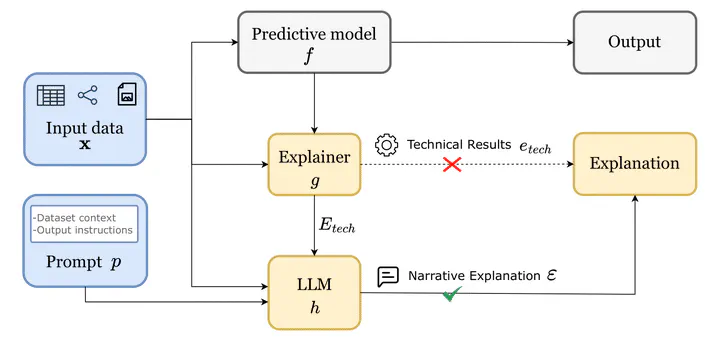
Given a predictive model $f$, an instance $\bm{x}$, and a corresponding technical explanation $e_{tech} = g(f, \bm{x})$, the objective is to derive a narrative explanation $\varepsilon$ trough a generative function $h$ conditioned on a guiding prompt $p$:
$$\varepsilon = h(p, \bm{x}, e_{tech})$$where $h$ transforms the structured information about the instance $\bm{x}$ contained in $e_{tech}$ into a linguistically coherent and semantically faithful textual narrative (see figure above).
Our works
- NATURAL LANGUAGE COUNTERFACTUAL EXPLANATIONS FOR GRAPHS USING LARGE LANGUAGE MODELS
- Enhancing XAI Narratives through Multi-Narrative Refinement and Knowledge Distillation
- A Survey on Explainable AI Narratives based on Large Language Models
Thesis Projects
Prerequisites
- Less than two exams left in your career
- Coding skills:
- Python
- Github
- Basics of LLMs theory and usage
1. XAI Narratives for Time-Series
Integrate state-of-the-art XAI methods for time-series data in the XAI Narrative pipeline, focusing on how to represent the task to the (multimodal) LLM.
2. XAI Narratives for Images
Integrate state-of-the-art XAI methods for image data in the XAI Narrative pipeline, focusing on how to represent the task to the multimodal LLM.
3. Agentic AI Framework for advanced XAI Narratives on Large Graphs (advanced)
Develop an agentic framework that allows LLMs to create XAI Narratives on large-scale graphs, splitting the task into multiple sub-tasks to solve the problem of the context window of LLMs.